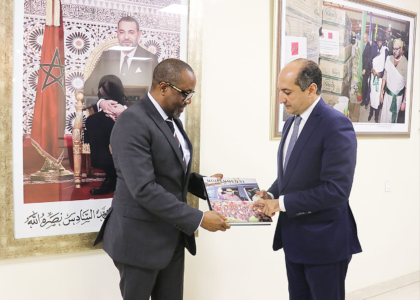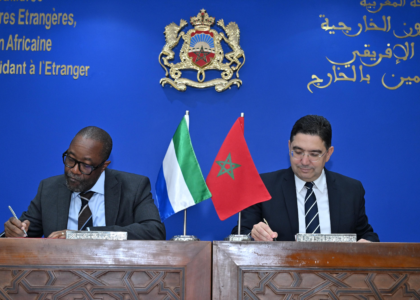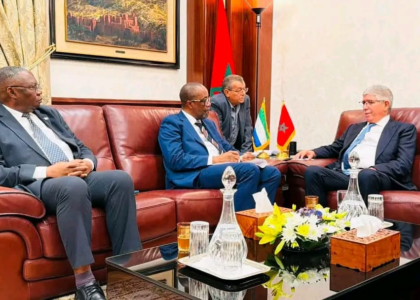

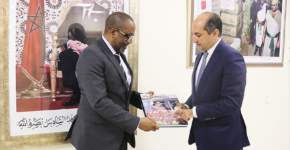
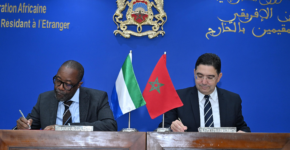
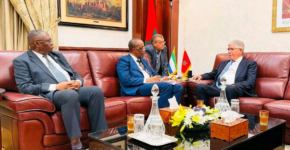

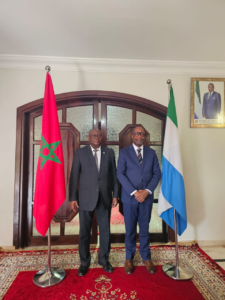
 Rabat, Morocco, 17 November 2026- Sierra Leone’s Minister of Foreign Affairs and International Cooperation, Mohamed Rahman Swaray, has urged the country’s diplomatic missions abroad to move beyond traditional diplomatic engagements and prioritise activities that deliver measurable benefits to citizens and improve living standards at home.
Minister Swaray was addressing officials at the Sierra Leone Embassy in Rabat, Morocco, during a working visit to the Kingdom. He said the government expects its foreign missions to play a more active role in advancing its development agenda, attracting opportunities, and accelerating the implementation of its manifesto commitments.
He affirmed that the government had clearly outlined what it intends to achieve while in office, supported by the National Medium-Term Development Plan and its five Big Changers, and stressed that diplomatic missions must align their work with these national priorities.
“The manifesto is very clear about what we want to deliver while in power, and how we want to accelerate delivery. We want the missions to play their part,” he maintained.
The Minister argued that traditional diplomatic activities, including official dinners, handshakes and ceremonial photographs, were no longer sufficient measures of diplomatic effectiveness in an increasingly challenging international environment.
“The rules-based multilateral order that we know is changing faster and furiously,” he cited declining overseas development assistance and changing priorities among international partners.
He mentioned the United Kingdom as an example, saying Sierra Leone was facing a substantial reduction in British development assistance, underscoring the depreciating funding around £70 million to £80 million to now fallen significantly, with allocations eventually reaching £5 million.
The Minister acknowledged that international partners were increasingly dealing with their own economic and domestic challenges, making it necessary for Sierra Leone to rethink how it engages with development partners and mobilises resources.
He therefore challenged embassy officials, particularly information attachés, to move away from reporting ceremonial activities that did not translate into tangible development outcomes.
“I even want to encourage the information attachés not to report handshakes and photographs that don’t translate into practical, on-the-ground improvements in the living standards of our people,” he said.
Diplomatic missions must justify public expenditure
Minister Swaray also raised concerns about the need for foreign missions to demonstrate value for money, noting that the government spends approximately four per cent of the national budget on its diplomatic missions.
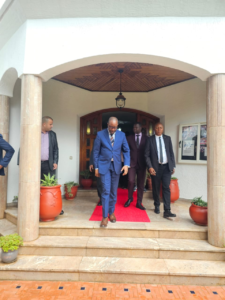 He said the public increasingly wanted to understand what Sierra Leone’s missions abroad were achieving, particularly at a time when the country faced competing development priorities and limited financial resources.
The Minister said his vision for the Foreign Ministry would involve more engagements in the coming days and weeks, with particular emphasis on improving the effectiveness and efficiency of service delivery.
He described the approach as achieving “small resources, big impact”, arguing that administrative reforms and better use of technology could help reduce bureaucratic inefficiencies while improving the performance of diplomatic missions.
Digital registration of Sierra Leoneans abroad
As part of the proposed reforms, Minister Swaray disclosed plans to introduce a digital registration system that would enable Sierra Leoneans travelling or residing abroad to register with their respective diplomatic missions.
He said the initiative would help missions maintain records of citizens in their jurisdictions, whether they were travelling for business, education or other purposes.
“We want every Sierra Leonean who comes here, whether it is for business or for schooling, to be able to register with you so you know they are here. So we are digitalising,” he said.
The proposed initiative signals an effort to strengthen consular services, improve communication with Sierra Leoneans overseas and enable diplomatic missions to better understand and respond to the needs of citizens within their areas of responsibility.
Sierra Leone’s Medium-Term National Development Plan 2024–2030 is anchored on five Big Five Game Changers: Feed Salone, Human Capital Development, the Youth Employment Scheme, Technology and Infrastructure, and Transforming the Public Service Architecture.
Swaray’s remarks point to a broader expectation that the country’s foreign missions should become more development-oriented, using diplomacy not simply to maintain international relationships but also to attract investment, expand economic partnerships, facilitate opportunities and contribute directly to national development.
As Sierra Leone navigates changing international development financing and increasing demands on public resources, the challenge for its diplomatic service will be to translate international relationships into measurable domestic benefits.
Aminaash Nyande Brima
Information Attaché
Sierra Leone Embassy,
Rabat, Morocco